 SEED 5 DOWNLOAD
[1] XORG
SEED 5 DOWNLOAD
[1] XORG
Think of organizational licenses as unexplored terrain - not just legally, but culturally and socially. When we look at this space, we don't see the well-worn paths of shared experience or the accumulated wisdom of practice. It's a landscape that exists more in potential than in reality, defined by what could be rather than what already is.
We need tools for exploration of this space -- a "vessel" that allows us, and others, to navigate this space. What follows is our blueprint for this vessel, though blueprint might be too rigid a word. Consider it instead a first attempt at articulating something that will inevitably evolve through use, through the practical wisdom of navigation.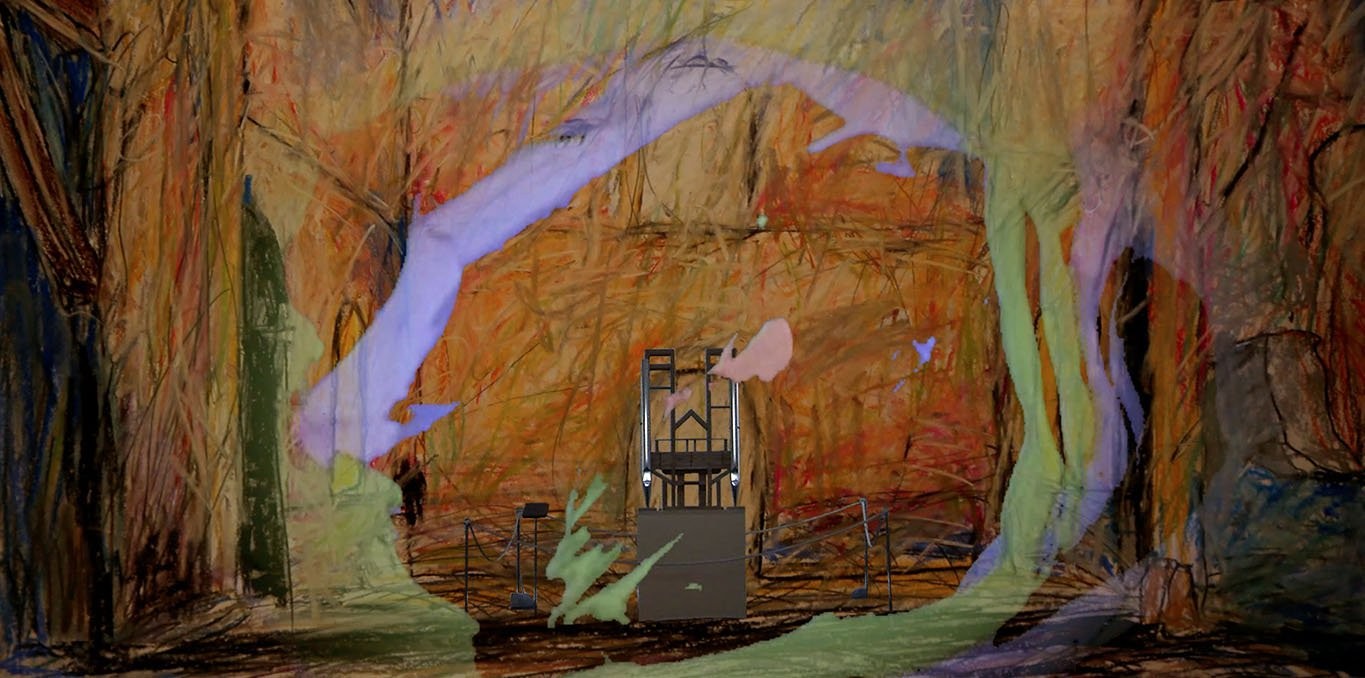 Still from John Cage - Halberstadt by Pierre Hébert
Play (the Lightness of Speculative Engagements)
We approach film differently here, organizing possibilities to play with films. Imagine gatherings where every pause, every rewind, every moment of collective attention becomes part of a larger game. We call this Possible Cinema - a practice that transforms passive viewing into active engagement.
Possible Cinema starts from the premise that any interaction with a film is a form of play: watching, commenting, re-enacting, and so on. The game offers diverse patterns of engagement for cinematic encounters, expanding how we interact with films. The game treats any film like a game board – its frames and sequences creating territories for exploration. The movie becomes the main surface of play, upon which a variety of interactions are composed, turning familiar actions into meaningful moves.
How to play upon the game board of a film, then? To enable the play, we’ve compiled possible interactions during a film, expected or unexpected, and translated them into game moves. This expression of interactions as moves is an adaptation from paradigms developed within tabletop RPGs over the last decade. The approach we've developed provides a flexible way of “translating” mundane activity into modular building blocks for composing game-like systems. The research is also inspired by the cultural practices around moving images investigated within United Screens through the years.
For example, think of what happens when you pause a movie with friends. Usually it's just a break, a moment to grab snacks. But imagine if each pause opened a door: suddenly everyone has to share what they're thinking about that exact frame. One person sees a hidden detail in the background, another connects it to a memory, a third spins it into a question about where the story might go.
The action of pausing can come with a right (or an obligation) to ask a question related to the film and its current scene and the film will not continue before someone offers a response (not necessarily an answer) to this question. This simple change of interaction can already form a root for play.
What starts as a simple twist in how we watch together becomes a generator of new meanings, new ways of seeing. The film stops being just something we consume and becomes more like a living text, growing and changing through our collective imagination.
Sooner or later, these experiments inevitably lead into a legally hazy area.But that's exactly the point. The friction itself becomes generative, creating space for something new: a meta-game where temporary cinemas can be summoned into existence, wherever and whenever people gather to play with light and shadow.
Play upon Films; Play of Cinemas
 Still from Eye Test by Sudha Padmaja
To arrive at the layer of cinema, we can start with an observation. Think of a deck of playing cards. That same deck yields poker, solitaire, blackjack - each game complete and distinct, yet born from identical raw materials.
In our approach, films work the same way. Each viewing can spawn its own game with unique rules, each revealing different facets of the same cinematic raw material. The film becomes our deck of cards, holding infinite potential for play: a game of games.
To harness this potential of the context it establishes, the game integrates its cinematic layer in the following fashion:
• Each screening becomes a living laboratory. The film plays, someone suggests a new way to interact with it, possibly modifying their rules during the play. The building blocks are simple enough that such modifications can be created collectively or a more experienced player might guide. Each successful experiment becomes a seed for future sessions, evolving our shared language of play.
• Any play that proves itself intriguing can be framed, and expressed in the form of a repeatable game: a storable and shareable social pattern that can be rejuvenated back into play.
• This is where the magic happens: anyone hosting these games can summon A Possible Cinema into existence. Your living room, a backyard, an abandoned warehouse - each space becomes a temporary outpost of this wandering cinema. Appearing wherever it’s being played, maintaining consistent branding and publicity across different locations. .You get to use the name, you can link it to a possible organization, become part of a network of similar spaces flickering in and out of existence across cities and towns.
• As a result, each instance of A Possible Cinema operates in a type of pocket reality, turning homes into cinemas, perhaps with particular films and games curated for them (with popcorn or not), while uniting under the same organizing identity.
• It should be noted that playing in the cinema is optional. If one is happy to play a film as a private game with some friends, nothing prevents this. The layering is essentially optional.
A note on the curious form of existence created by such a structure: while this cinema is, in some ways, limited to its magical form of existence, there are ways to hook it to everyday reality. In short, yes, it is still a game – but a game can be slotted to a recognized existence.
From this perspective, the events of the play, or appearances of A Possible Cinema, can take place as events in everyday reality: someone could visit such a cinema without knowing much of the larger framework around it, and still be able to play along. At the same time, though, every activity in the cinema can be approached as being a fictional play, akin to a Live Action Role Play (LARP).
In essence, the game is simultaneously a concrete piece of reality and a cloud of fictional play.
The Solid Seeds of Licenses
After summarizing this venue-layer of the game we can (finally) address the problems of hazy legal relations such play creates with films, especially for publicized events of the play. This brings us to licenses.
While we start at play, engaging the interactions through light and easily modifiable expressions, to tap into the fuller potential opened by this game, some form of organizational solidity would be beneficial. Thus, in the longer term, seeding its soil by licenses, as solid points to grow upon, is a core part of our strategic map -- part of the game design, even.
Licensing the Possible Cinema, or the possibility operate A Possible Cinema, offers myriad benefits. It brings clarity and solidity to players' shared rights, fostering a collective identity and a communal pool of development resources. Similar to recent game licensing models like OGL, this shared framework allows for common mechanics of play, enabling seamless integration and collaborative contribution.
There's a second major benefit to this area of licensing: it provides an anchor for licensing films, from and toward the cinema. As mentioned earlier, the legal situation of such play, if publicized, is potentially problematic. Yet, individual films can license themselves for distribution through A Possible Cinema, either as a commercial or non-commercial license (can tickets, or popcorn, be sold in a particular when playing with a particular film?).
Pragmatically, yielding to such a license might be difficult, even impossible, for a film that is part of dominant distribution channels. But this is a potential strength in the guise of weakness: our interest is to proliferate channels for films outside of current circulations. This possibility, limited to films that have access to inner circles, is an opening for films that have been left out. It could conceivably grow to an alternate form of circulation, upwards from the grassroots of living rooms and abandoned backyards as summoning places of A Possible Cinema.
This is also why the possibility of licensing a film for particular games is an important piece in the puzzle: it enables the makers of a film to curate the interactions they desire around their film. As mentioned in the beginning, the traditional form of watching a film is treated as "just another game" in this context. This means that such interaction, usually assumed by makers of films, can be included in its palette. At the same time, the Possible Cinema exposes films to the possibility of expanded social interactions, thus reconsidering film as a social and cultural catalyst.
Conclusion. The Vessel of the Game as a Catalyst of Cultural Reflection
In addition to its exposure, the game subtly invites a broader reassessment: it’s a glimpse into a wider reconsideration of the cultural roles of media at large. It’s a crack in the establishment of consumerism and a call for participation. Possible Cinema is a laboratory for creating ever-new relations with the media we live with.
Meshdia researches, designs, and prototypes new circulations for cultural work(s). We conceive media as networks and networks as media.
Meshdia moves in two directions:
- Create bottom-up and plural counter-infrastructures opening up new spaces within society.
- Intertwine game design, philosophy, legal, and technological imagination for growing new branches of culture.
We are currently researching and designing a social protocol for re-imagining cinema circulation. The Possible Cinema Protocol channels the cinephile's labors of love into new playful forms of sharing, disseminating movies in alternative ways.
For its existence, Meshdia thanks SAVVY Contemporary (United Screens) and Beyond Culture of Ownership, a program by Serpentine Galleries and RadicalXChange, for their support.
Interested in new counter-infrastructures of sociality? Contact us via email or in our Telegram group.
